Downloadable kit
Agent Efficiency Kit
Kit files are in English.
Find and reduce wasted tokens in your Claude Code sessions with local hooks and a usage dashboard.
For developers already running Claude Code locally.
$49.99One-time payment
I'm a subscriber: check my accessYearly: every kit included. Monthly: one new kit per billing cycle.
Delivered downloads are non-refundable. Return policy
 View full-size sample ↗
Access, downloads and refund policy
Yearly: every available kit and bundle, unlimited downloads.
Monthly: one new standalone kit per billing cycle, no bundles. Re-downloads are free and do not use a new claim.
Monthly subscriptions started before February 28, 2026 keep all-access, including bundles and unlimited downloads.
Monthly access currently allows three downloads per kit. Need another? Contact joozio@hey.com.
Download access while subscribed. Keep the files you download.
Digital downloads are non-refundable once delivered. We resend broken links, replace corrupt files and review products significantly different from their description case by case. Contact joozio@hey.com with your order details. Return policy
How it works
Cut Claude Code token waste from day one. Drop-in hooks prevent redundant file reads, WebFetch Cloudflare walls, retry spirals, and wrong-model overkill. Local dashboard shows cluster forensics and daily heatmap. Built from auditing 133,087 real sessions. 12 months of updates.
Built from auditing 133,087 real Claude Code sessions. Hooks work from the first run.
Latest update: 2026-09-09
September 9, 2026: Routing notes, README and agent instructions moved to the current lineup (Fable 5.1, Opus 5, Sonnet 5, Haiku 4.5). The cost reporter gained a claude-fable-5-1 row and its Sonnet 5 rate was corrected to the standing $2 / $10, which had been overstating Sonnet 5 cost estimates by 50%.
What you get
Package includes
- •install.sh: one-line installer that patches ~/.claude/settings.json safely (preserves existing hooks)
- •AGENT_INSTRUCTIONS.md: prescriptive rules for the agent (~1k tokens, cacheable)
- •analyze.py: heuristic classifier, free, no LLM required
- •taxonomy.py: waste bin definitions (9 categories), pure functions, easy to extend
- •report.py: JSON + Markdown report builder
- •subagent_link.py: links sub-agents to parent sessions for attribution
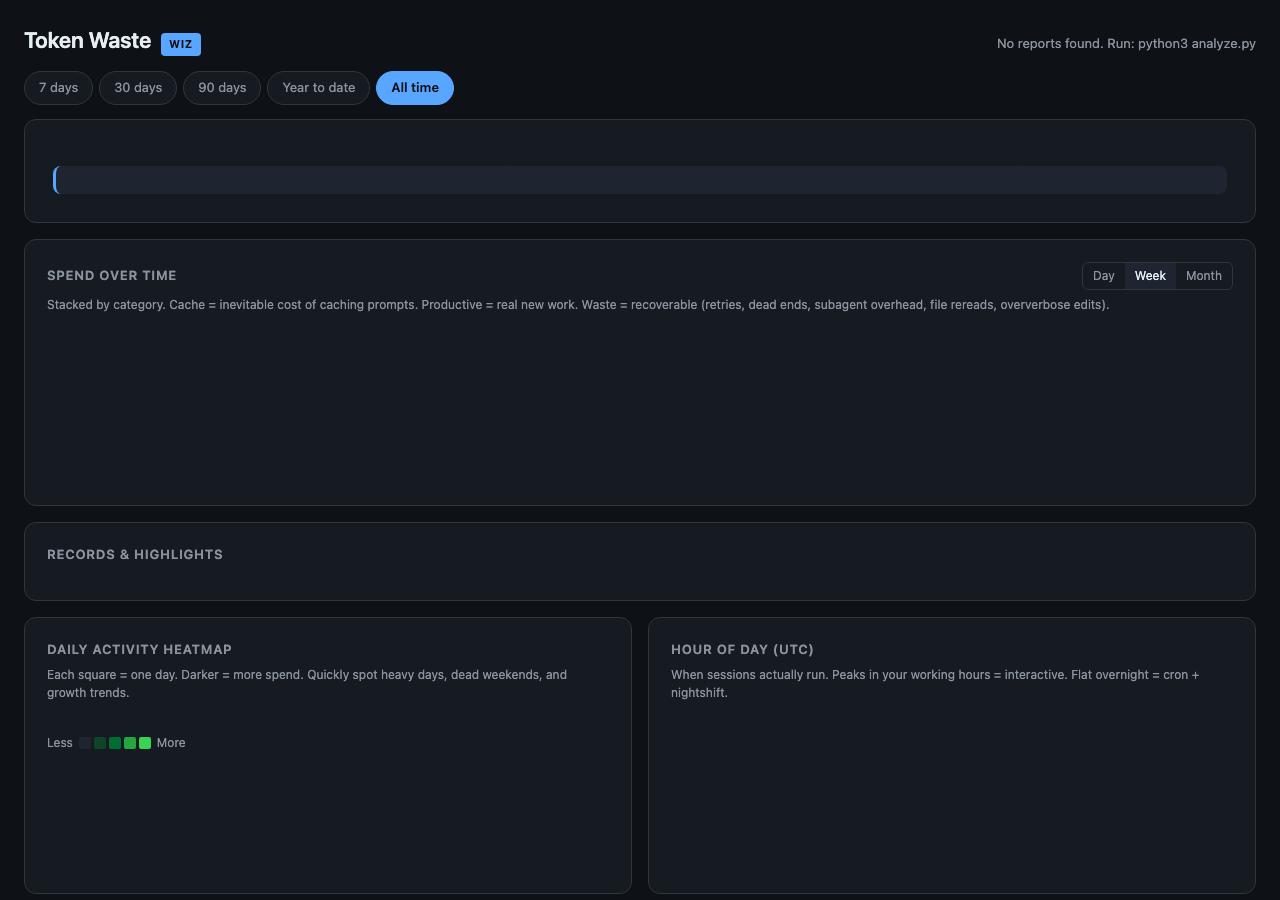
- •dashboard.py: local web dashboard at localhost:8765
- •llm_classify.py: optional Haiku-powered deep audit (OpenRouter or Claude CLI)
- •hooks/: three shell scripts (file-reread-guard, webfetch-fallback-guard, webfetch-circuit-breaker)
- •lib/: Python helpers backing the hooks
- •model-routing-notes.md: task-to-model rules for Fable 5.1, Opus 5, Sonnet 5, Haiku 4.5, and local models
- •12 months of updates: new hook patterns, taxonomy expansions, dashboard features
FAQ
Does this only work with Claude Code?
Yes. The hooks use Claude Code's PreToolUse/PostToolUse hook system and the dashboard reads Claude Code session JSONL files. It will not work with Cursor, Aider, or other tools.
Will the hooks slow down my sessions?
No. Each hook runs a tiny Python or shell script. The file-reread guard does a hash lookup. The WebFetch guards do a simple counter check. Total overhead per tool call is under 50ms.
What if I already have hooks in my settings.json?
install.sh merges the new hooks into your existing configuration. It reads your current hooks array, appends the kit hooks, and writes back. It creates a backup (.bak) before modifying.
How do I read the dashboard?
Run `python3 analyze.py --no-llm` to classify your sessions, then `python3 dashboard.py` to open the dashboard at localhost:8765. The cluster forensics section shows the specific patterns burning tokens in your projects.
How does the 12-month update policy work?
Your purchase confirmation email has a download link. Reuse that link within 12 months of purchase to get the latest version. After 12 months, you keep what you have, and the hooks keep working.