Downloadable kit
Agent Attention Kit
Kit files are in English.
See where your agent decisions land and hand the ones that do not need you to a default your agents can act on.
Python 3.9+. For anyone running several agents a day who wants fewer, better-framed calls.
- Audit a week of agent check-ins: decisions a day, minutes, and where they land in your loop.
- Route each decision into one of five modes with six rules you can read and change.
- Promote a decision class only after 20 accepted defaults, and review the week with unknown never counted as zero.
Local Python kit | ZIP, guide and reports in English | Offline demo
$39One-time payment
I'm a subscriber: check my accessYearly: every kit included. Monthly: one new kit per billing cycle.
Delivered downloads are non-refundable. Return policy
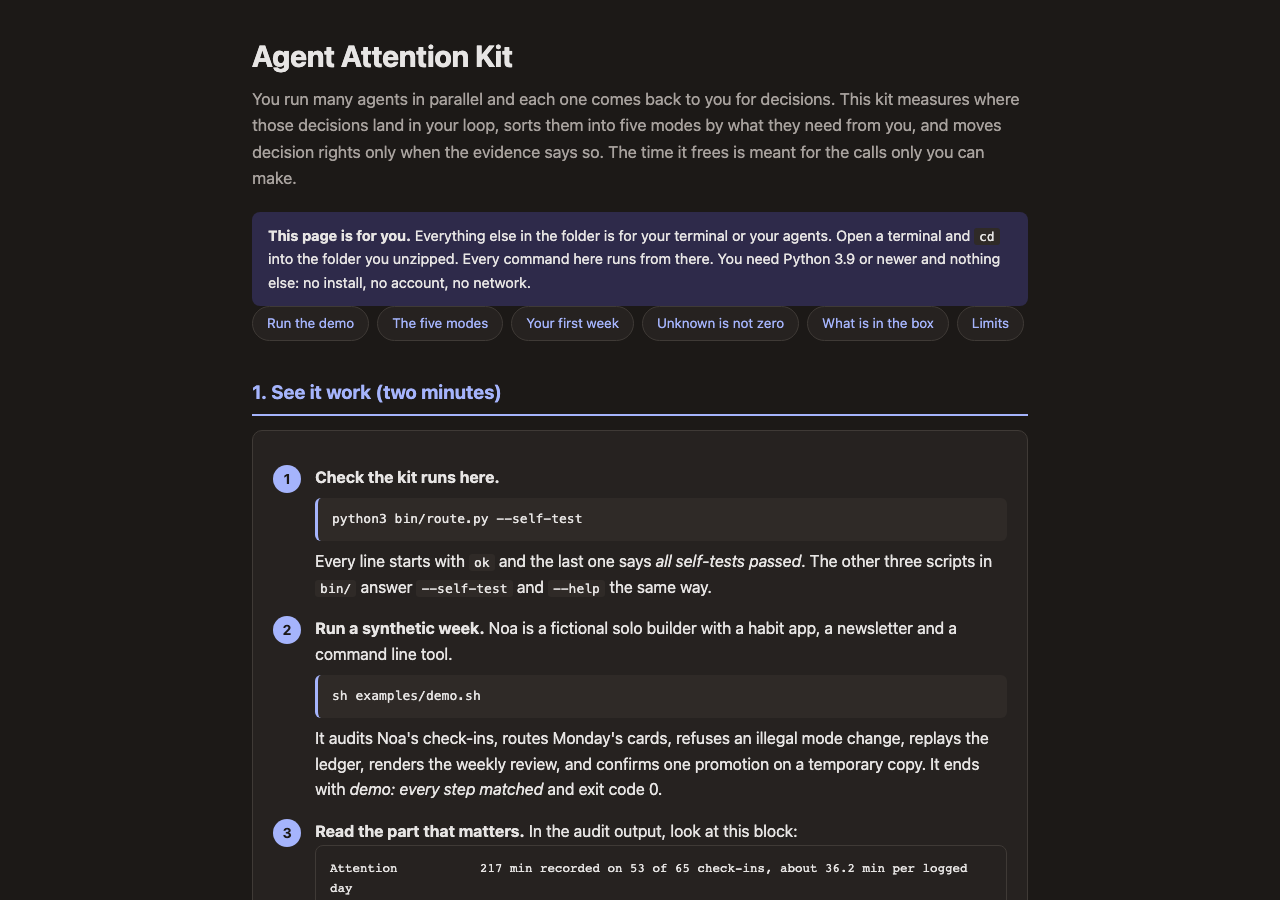 View full-size sample ↗
Access, downloads and refund policy
Yearly: every available kit and bundle, unlimited downloads.
Monthly: one new standalone kit per billing cycle, no bundles. Re-downloads are free and do not use a new claim.
Monthly subscriptions started before February 28, 2026 keep all-access, including bundles and unlimited downloads.
Monthly access currently allows three downloads per kit. Need another? Contact joozio@hey.com.
Download access while subscribed. Keep the files you download.
Digital downloads are non-refundable once delivered. We resend broken links, replace corrupt files and review products significantly different from their description case by case. Contact joozio@hey.com with your order details. Return policy
How it works
You run many agents in parallel and each one comes back to you for decisions. This kit measures where those decisions land and gives the ones that do not need you somewhere else to go. Log a week of check-ins and the audit shows decisions a day, the minutes they cost, and the share that lands at the start of your loop (direction), the middle (corrections) and the end (approvals and quality checks). A router sorts each decision into five modes, Auto, Default + veto, Test, Ask and Direction, with six rules checked in order: anything one-way, with side effects, or touching customers, the public or money stays with you. An autonomy tracker counts accepted defaults per decision class and suggests a promotion at 20. Silence never counts, a veto or a reversal demotes the class, and nothing is promoted until you confirm it. A weekly review renders the counts, and a number nobody recorded shows as unknown, never as zero. Also inside: a decision card template, an instruction block for your agents and a daily dogfood log prompt. Extracted from Decision Layer, the decision system I run my own projects on. Standard library Python, no account, no network: the demo runs a synthetic week offline.
Extracted from Decision Layer, the decision system the author runs his own projects on. 121 tests on Python 3.9 and 3.14 as of October 31, 2026
Latest update: 2026-10-30
v1.0.0 (2026-10-30). First release.
Best for
- +Anyone running several agents a day who answers the same kinds of questions over and over
- +Builders who want agents to settle the reversible calls and bring them only the ones that need them
- +People who want decision rights to move with evidence they can read, not with a feeling that the agent is doing fine
Not for
- -Running or talking to your agents. The instruction snippet tells them how to file decisions; the scripts read what they file
- -Judging whether a decision was right. The outcome check on each card does that if someone reads it, and the review lists the ones nobody did
- -Checking that an agent stated reach and reversibility honestly. Side effects route to Ask whatever the card says, and one veto demotes a class, which limits the damage
- -Decision Layer itself. The kit re-implements its five modes, routing rules, earned autonomy and weekly review as small scripts; the larger system is not included
What you get
Package includes
- •START-HERE.html: run the demo, the five modes, your first week, and the limits
- •bin/: audit.py, route.py, autonomy.py and review.py
- •guide/: six chapters, from auditing your loop to the routing rules, earned autonomy, the weekly review and the dogfood log
- •templates/: check-in log, decision card in markdown and JSON, ledger events, class rules, weekly review and dogfood log
- •prompts/: the instruction snippet for your agents, the daily dogfood log prompt, and a prompt that rebuilds a check-in log from history
- •examples/: Noa's synthetic week (check-ins, ledger, class rules, cards, dogfood log) and demo.sh
- •tests/: tests for the audit, the router, the autonomy tracker and the review
- •README.md, MANIFEST.txt, CHANGELOG.md, LICENSE.txt
FAQ
Does it work with my agents?
With any agent that reads an instruction file. Paste the snippet from prompts/agent-instructions.md into CLAUDE.md, AGENTS.md, a system prompt or a project rules file and replace three values. If your agents cannot write files, drop the ledger section and keep the rest: the rules for how to ask are most of the value.
Will my agents start deciding things on their own?
Only where you let them. Nothing is Auto unless a class rule you confirmed says so, and a rule without "confirmed": true is ignored. One-way doors and side effects go to Ask whatever a class has earned, and the tracker suggests promotions but never applies one without you.
Why does silence not count?
A Default + veto that landed because nobody vetoed is no evidence about your judgment. If silence counted, a class would climb toward Auto during the weeks you were too busy to look, which is exactly when it should not.
Do I have to log a week before it is useful?
The audit needs a week of check-ins. Log them as they happen in templates/checkin-log.csv, or rebuild a week from history in about ten minutes with prompts/build-checkin-log.md. The demo runs a synthetic week first, so you can see every output before you log anything.
Does anything leave my machine?
No. There is no account, no network and no telemetry: every script reads local files and prints to your terminal.
What do I have to install?
Python 3.9 or newer, standard library only, and a POSIX shell for demo.sh. Tested on macOS on Apple silicon under Python 3.9.6 and 3.14.3: every self-test, all the tests and the demo. No Linux or Windows run has been recorded.